Texas · TX Daily News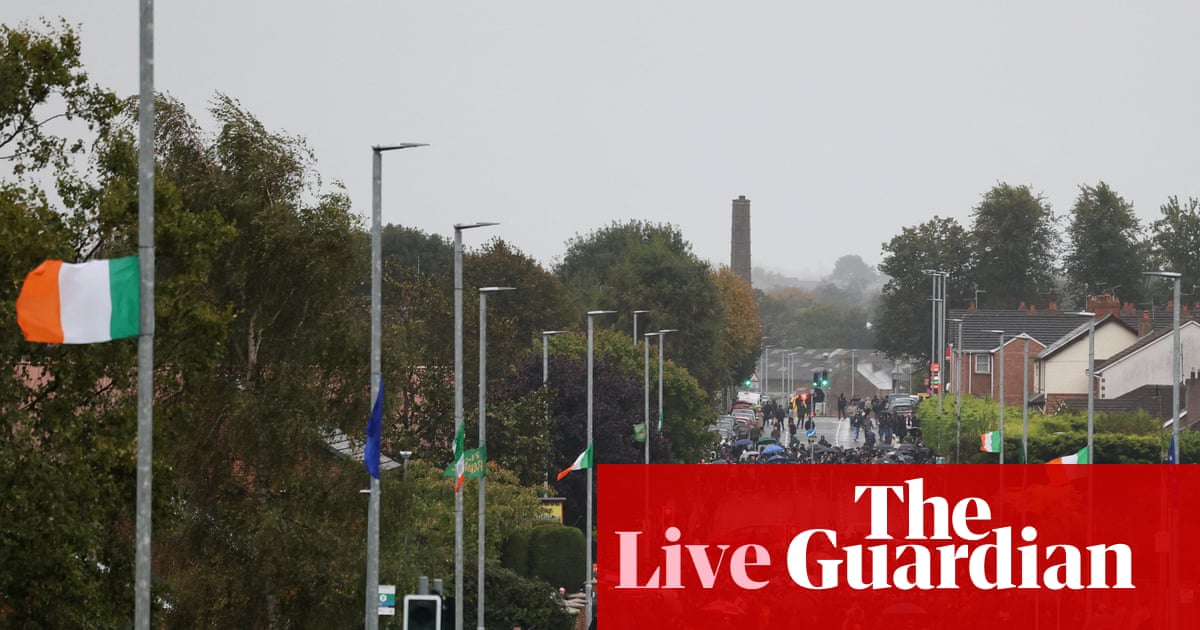
From 41m ago Loyalist march takes place for first time since 1998 Lisa O’Carroll The controversial loyalist march down a mainly Catholic Road in Northern Ireland , banned for almost 30 years because of violence, has begun after an appeals court ruled in the small hours of Sunday morning it was legal. Protestors braved heavy rain in Portadown on Sunday morning as they gathered at the scene of the contentious Drumcree parade, which starts at Drumcree church and proceeds through the town including the mainly nationalist Garvaghy Road. The crowds, many of them wearing balaclavas, clustered in large groups along Garvaghy Road in the hours leading up to the start of the parade at 8am.
First minister Michelle O’Neill said the original decision to allow the march was “primitive stuff in the year 2026” while unionists said Catholics had “nothing to fear”. Key events 22m ago Just 35 Orangmen protesters authorised for march 37m ago A history of disorder with the parade 41m ago Loyalist march takes place for first time since 1998 1h ago Opening summary While the Orangemen march has begun, there’s no sign yet of the two groups coming within sight of each other. The Parades Commission had ruled that the march could go from 8am to 9.30am.
Police officers and vans are present at the counter-protest along Garvaghy Road, where at least hundreds if not thousands have blocked the route. Earlier, police had blasted out a message over the speakers that taking part in the demonstration could be a criminal offence, a warning that hasn’t dispelled those gathered. Just 35 Orangmen protesters authorised for march The Parades Commission has authorised a small group – of just 35 Orangemen – to march along the road silently this morning.
They’ve not been allowed bands or supporters. The Parades Commission is the independent body in Northern Ireland adjudicating on controversial marches and protest – because of a history of such events being a trigger for wider sectarian violence. Northern Ireland saw three decades of conflict between largely Catholic, pro-Irish republicans and Protestant, pro-UK unionists.
Garvaghy Road had been a major flashpoint of the unrest in the late 1990s. But the Commission this year determined that the Orange Order could make the return leg of their route through this part of town, having barred the Order the last almost 30 years. Lisa O’Carroll My colleague Lisa O’Carroll has been reporting from Garvaghy Road this morning, where senior Sinn Féin leaders had joined the counter-protest.
Leader of Sinn Féin, Mary Lou McDonald, said the appeal court’s decision to allow the march go ahead was “disgraceful”. “The decision tonight to overturn the court ruling, and force an unwanted orange march through the Garvaghy Road is disgraceful. “This march is steeped in a history of hate, sectarian violence, and murder, and championed by Unionist leaders”.
Mary Lou McDonald, leader of Irish republican and democratic socialist political party Sinn Fein, speaks to media at the Garvaghy road Photograph: Cathal McNaughton/Reuters A history of disorder with the parade Lisa O’Carroll The Orange Order, one of the most prominent organisations within unionism, insisted that the Garvaghy Road is part of its traditional marching route but the event is opposed by many Catholic residents who live there. The parade was last permitted down Garvaghy Road in 1998 after a wave of violence followed clashes on the street, with thousands of public order incidents across Northern Ireland including murders. A ruling by the Parades Commission permitting the Orange Order to march on Garvaghy Road was upheld at around 2.15am after an appeals court overturned a ruling by the High Court on Saturday to allow the procession, despite fears it could spark fresh sectarian violence.
Loyalist march takes place for first time since 1998 Lisa O’Carroll The controversial loyalist march down a mainly Catholic Road in Northern Ireland , banned for almost 30 years because of violence, has begun after an appeals court ruled in the small hours of Sunday morning it was legal. Protestors braved heavy rain in Portadown on Sunday morning as they gathered at the scene of the contentious Drumcree parade, which starts at Drumcree church and proceeds through the town including the mainly nationalist Garvaghy Road. The crowds, many of them wearing balaclavas, clustered in large groups along Garvaghy Road in the hours leading up to the start of the parade at 8am.
First minister Michelle O’Neill said the original decision to allow the march was “primitive stuff in the year 2026” while unionists said Catholics had “nothing to fear”. People block Garvaghy road, a Catholic enclave in the largely Protestant town of Portadown, on the day members of the Protestant Orange Order are expected to march through the area in Northern Ireland, September 27, 2026. Photograph: Cathal McNaughton/Reuters Hundreds of protesters had gatherered overnight on Garvaghy Road to block passage to the group of Protestant marchers.
Pictures from the scene show a sizeable crowd with protesters linking arms several rows deep. Sinn Féin has posted some footage from the protest, describing it as “thousands standing proudly in solidarity with Garvaghy Road residents. “Peace and progress must be protected.
We reject unwanted orange marches.” Northern Ireland’s First Minister Michelle O’Neill had condemned the late- night court ruling allowing the march to proceed. “Our message tonight is clear. There is no going back.
Not tomorrow. Not ever.” Sinn Féin supported the residents of Garvaghy Road to protest against “this unwanted sectarian march,” she said. Opening summary Hello and welcome to our live coverage of the latest news in Northern Ireland after a Protestant march was permitted to go ahead on Sunday for the first time in almost 30 years.
The original dispute over the route of the Orange Order parade down the Garvaghy Road in Portadown became one of the defining flashpoints of the conflict in Northern Ireland. Here is a quick recap of the latest: A Protestant parade may proceed through a Catholic area, Northern Ireland’s high court ruled early on Sunday , reversing a temporary ban on the highly charged march in an area that has historically been a flashpoint of sectarian disputes. The high court dismissed a new application to stop the Orange Order from going through the area of Portadown after the court of appeal vacated a temporary injunction granted on Saturday to residents who opposed the parade.
Residents of the Garvaghy Road area had challenged Friday’s ruling by Northern Ireland’s Parades Commission that permitted the Orange Order to march along their road , a Catholic enclave in the largely Protestant town, overturning an almost 30-year ban on the route. A crowd gathered on the Garvaghy Road early on Sunday morning to protest against the ruling to allow the march. In the crowd were Northern Ireland first minister Michelle O’Neill, who is also vice-president of the Irish nationalist Sinn Féin party.
The party’s leader, Mary Lou McDonald, posted a video on social media of the gathering . “Although the forces of darkness may want to stop us creating a new united Ireland, they will fail,” McDonald told a crowd of protesters in the clip, posted on X. Annual attempts by the Protestant Orange Order to march through the area triggered unrest across the British-run region before the route was banned in 1998, the year the Good Friday agreement largely ended the three decades of violence known as the “Troubles”.
The Parades Commission’s determination on Friday stipulated that a smaller-than-usual 35 people could take part in the march, that it should begin by 8am (0700 GMT) and finish by 9:30am, and that no supporters or bands would be allowed.
Source: The Guardian